🚀 Key Highlights at a Glance
✅An MSP case study that advanced a vibration-sensor-based equipment management system into a predictive maintenance framework
✅Expanded equipment condition monitoring through Amazon Monitron integration
✅Implemented AI-powered diagnostics, reporting, and chatbot services with Amazon Bedrock
✅Established reliable collection and retention of large-scale equipment time-series data
✅Implemented cost controls and monitoring to prevent excessive Bedrock usage
✅Supported security reviews and horizontal rollout to additional plants based on AWS WAF, AWS CloudTrail, and the AWS Well-Architected Framework
Company
Korea Movenex is an automotive parts manufacturer that designs and produces drivetrain and steering components and supplies core components to vehicle manufacturers. Because the operational stability of precision machining equipment directly affects delivery schedules and quality, reducing unplanned downtime caused by equipment anomalies is a key factor in production competitiveness.
To address this need, Korea Movenex built and operated an AWS-based system that collects and manages equipment condition data through vibration sensors installed on key assets. As the Managed Services partner responsible for the overall AWS account, Doosan Corporation Digital Innovation BU (DDI) advanced the existing equipment management system into a predictive maintenance framework and implemented Amazon Monitron integration and generative AI diagnostic capabilities.
Engagement Overview – Contract and Service Period
-
Customer:
Korea Movenex
-
Industry:
Manufacturing (Automotive Parts)
-
Predictive Maintenance Enhancement Period:
December 28, 2023–April 30, 2024
-
Managed Services (MSP) Contract Start Date:
May 1, 2024
-
Managed Services (MSP) Contract End Date:
August 31, 2027 (12-month extension; operations currently ongoing)
-
Country of Service Delivery:
Korea (implementation and operations)
-
Scope of MSP Services:
Overall AWS account operations, predictive maintenance enhancement, Monitron integration, generative AI cost control, large-scale data collection and retention, security reviews, cost optimization, horizontal rollout to additional plants, and monthly operations reporting
-
Delivery Model:
Managed Services
Challenge
Korea Movenex had been operating its vibration-sensor-based equipment management system reliably and sought to advance it into a predictive maintenance framework capable of anticipating anomalies while establishing an operating foundation for sustained support.
-
Establishing professional operations across the AWS account.
Because equipment data collection, storage, analytics, and service delivery were operated within a single AWS account, a professional operating foundation was required to systematically manage infrastructure monitoring, incident response, change management, and security reviews. To allow Korea Movenex to focus more fully on production-site operations and equipment management, the company pursued an operating model in collaboration with a specialized partner.
-
Advancing predictive maintenance capabilities.
The existing system had effectively collected vibration data and provided visibility into current equipment conditions. To add early anomaly detection, failure-type identification, and maintenance timing prediction, diagnostic parameters, failure modes, diagnostic rules, and an analytics pipeline were required.
-
Need for Amazon Monitron integration.
In addition to its existing vibration sensors, Korea Movenex wanted to rapidly expand monitored assets by using Amazon Monitron, which is straightforward to install and operate. An integrated architecture was needed to manage data from different collection paths within a single predictive maintenance framework.
-
Introducing generative-AI-based diagnostics, reports, and chatbot services.
Interpreting vibration waveforms and equipment parameters, diagnosing anomaly causes, and preparing reports required a high level of expertise and careful review. A service architecture using Amazon Bedrock was needed to support Monitron data interpretation, predictive maintenance diagnostics, and field personnel Q&A, thereby assisting expert judgment and improving efficiency.
-
Reliable collection and efficient long-term retention of equipment data.
A management framework was needed to reliably collect high-frequency time-series data from multiple assets while optimizing retention for long-term use. The architecture also needed to improve continuity throughout collection and ensure analytical data consistency.
-
Advancing security and audit controls suited to the service.
Given the characteristics of an externally accessible monitoring service, Korea Movenex needed to strengthen web-layer security response capabilities and improve the audit foundation for systematically reviewing activity within the account.
-
Preparing for horizontal expansion across plants.
Because the scope was expected to expand after validation at the initial plant, the operating model needed to anticipate and address increases in data volumes and costs as plants were added.
As-Is Architecture
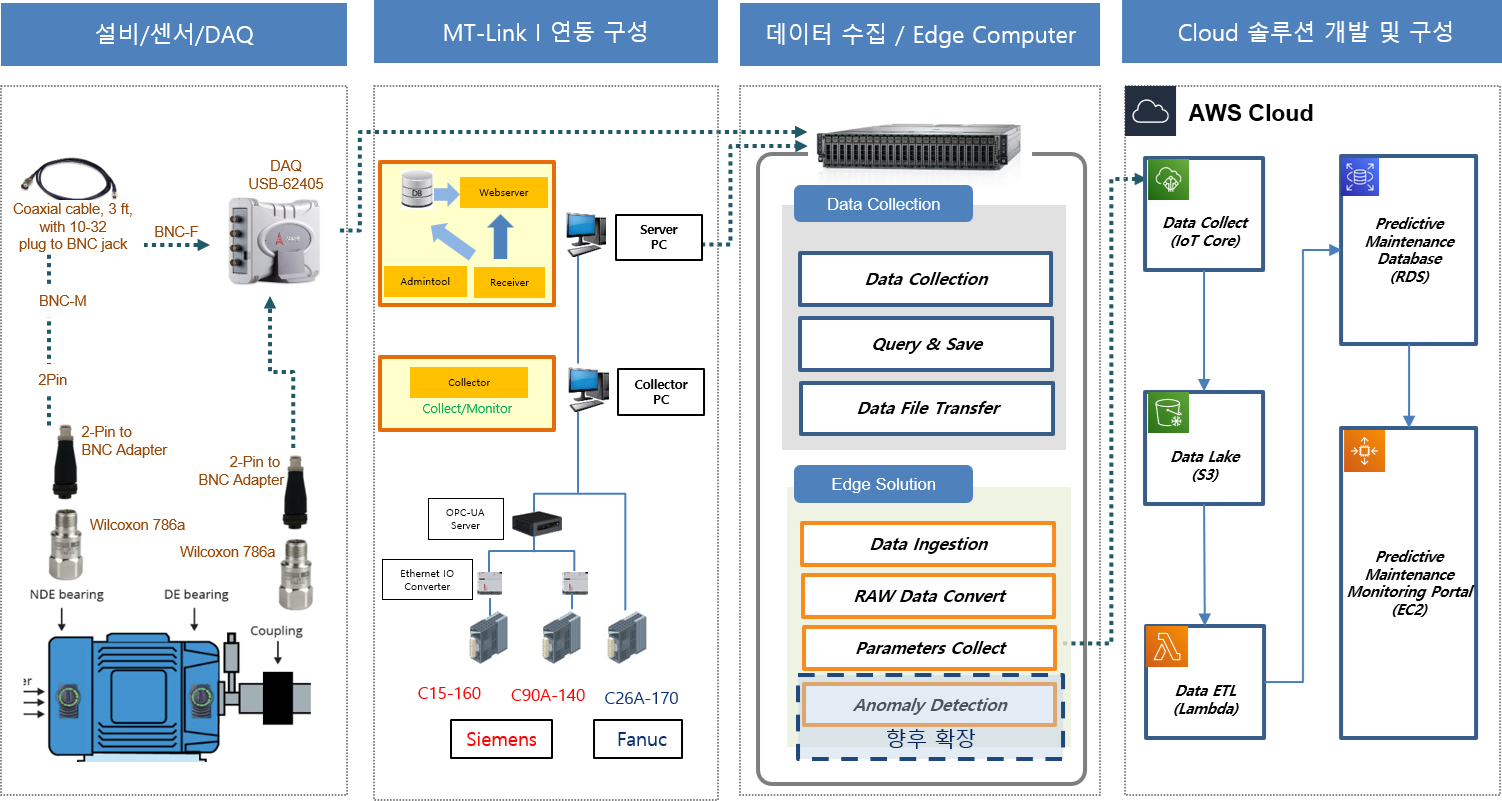
Before the MSP engagement, Korea Movenex’s equipment management environment was configured as follows.
Existing (As-Is) Vibration-Sensor-Based Equipment Management System Architecture
-
Vibration-sensor-based equipment management:
Data from vibration sensors attached to key assets was collected and used to view and manage equipment conditions.
-
Services deployed in the AWS Asia Pacific (Seoul) Region:
Core service workloads were deployed and operated in the Seoul Region.
-
Initial deployment at one plant with planned expansion:
The system was in operation at the first plant, with plans to expand to additional plants following validation.
Solution
DDI retained the existing equipment management system while adding a predictive maintenance analytics pipeline, Amazon Monitron integration, and generative AI diagnostics. It also established an integrated operating framework for the entire AWS account, generative AI cost controls, and a large-scale data retention architecture.
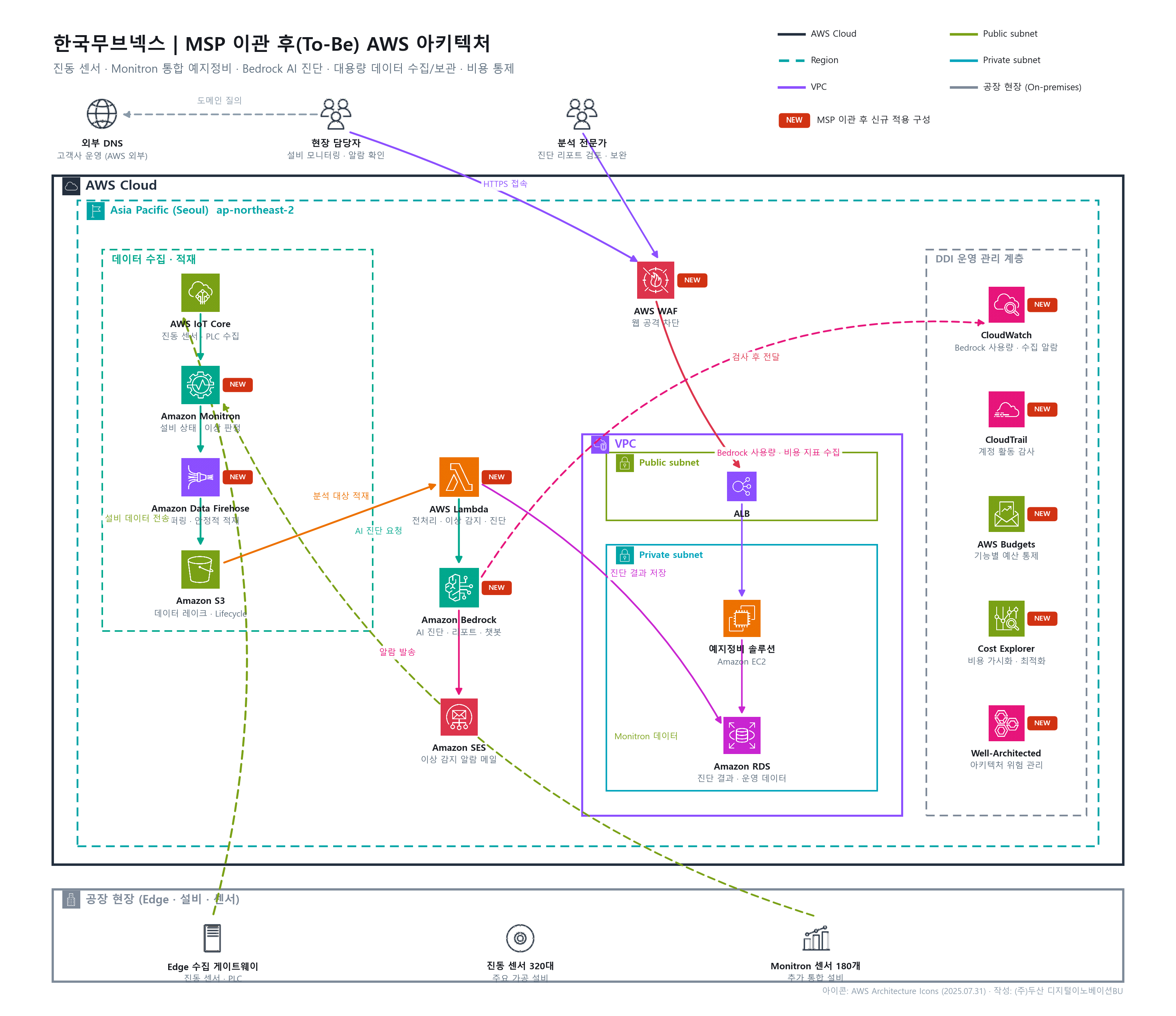
New (To-Be) Predictive Maintenance, Monitron Integration, and MSP Operations Architecture
-
Integrated and stabilized equipment data collection channels.
Vibration sensor and PLC data from the plant are connected to AWS IoT Core through an edge collection gateway, while Amazon Monitron sensor data is collected through the Monitron service. Data from both paths is buffered with Amazon Data Firehose and loaded into an Amazon S3 data lake without loss. CloudWatch alarms for collection failures and delays help prevent gaps in analysis.
-
Amazon Monitron integration and expanded monitoring coverage.
Additional Amazon Monitron sensors and gateways brought previously uncovered assets into scope. The data model and screens were integrated so that Monitron equipment-condition assessments and proprietary vibration-analysis results could be viewed and compared in the same predictive maintenance system.
-
Predictive maintenance analytics pipeline.
Data preprocessing, anomaly detection, and equipment diagnostics were implemented with AWS Lambda. Diagnostic parameters, failure modes, and rules standardized anomaly judgments and reduced variation based on individual experience. Results and operating data are managed in Amazon RDS, while the predictive maintenance solution runs on Amazon EC2.
-
AI diagnostics, reports, and chatbot powered by Amazon Bedrock.
Amazon Bedrock interprets vibration waveforms and equipment parameters, diagnoses anomaly causes, drafts diagnostic reports, explains Monitron results, and supports field personnel through a Q&A chatbot. Experts can focus on reviewing, refining, and making maintenance decisions rather than drafting reports from scratch. Amazon SES sends email alerts when anomalies are detected.
-
Long-term retention architecture for large-scale data.
High-frequency time-series data is stored in Amazon S3, with lifecycle policies automatically transitioning older data to lower-cost storage classes. Source data remains available for reanalysis while storage-cost growth is contained.
-
Enhanced security and auditability. AWS WAF
was placed in front of the externally exposed ALB to block web attacks and abnormal requests, and AWS CloudTrail was enabled to record and trace API activity. Excessive inbound security-group rules and unnecessary IAM permissions were remediated according to least-privilege principles.
-
Architecture validation based on the AWS Well-Architected Framework.
The architecture was assessed across operational excellence, security, reliability, performance efficiency, and cost optimization. An improvement roadmap was developed for identified risks and implemented in phases.
-
Horizontal plant rollout and continuous cost optimization.
Operating data from the initial plant is used to estimate collection capacity, storage cost, and analytics throughput for each new plant. Cost Explorer and budget alerts continuously track cost trends and identify optimization opportunities.
Predictive maintenance operating model built on key AWS services
-
AWS IoT Core:
Collection channel connecting vibration sensor, PLC, and other equipment data to the cloud
-
Amazon Monitron:
Equipment condition monitoring and anomaly assessment (additional integration)
-
Amazon Data Firehose:
Buffering and reliable ingestion of large-scale time-series data
-
Amazon S3:
Equipment source-data lake and lifecycle-based long-term storage cost optimization
-
AWS Lambda:
Data preprocessing, anomaly detection, and equipment diagnostics
-
Amazon RDS:
Diagnostic result and operational data management
-
Amazon EC2:
Operating environment for the predictive maintenance solution
-
Amazon Bedrock:
AI-based equipment diagnostics, automated diagnostic reports, and chatbot
-
Amazon SES:
Anomaly alert emails
-
Elastic Load Balancing (ALB):
Service traffic distribution
-
AWS WAF:
Web-layer attack protection and security for externally exposed services
-
AWS CloudTrail:
Auditability through account activity recording and tracking
-
Amazon CloudWatch:
Metric and log monitoring, including Bedrock usage, and collection failure alerts
-
AWS Cost Explorer / AWS Budgets:
Cost visibility and feature-level budget threshold alerts
-
AWS Well-Architected Tool:
Identification and management of architecture risks and improvements
DDI Support Services
As the Managed Services partner, DDI provided continuous support from pre-transition assessment and enhancement through post-transition operations.
-
Pre-transition support.
DDI assessed the data flows and overall AWS configuration of the existing vibration-sensor-based system and defined the scope and phases required to advance it to predictive maintenance. Initial standards were established for asset-level diagnostic parameters, failure modes, and rules, and assets targeted for Monitron were selected. Security settings, IAM permissions, network configuration, and cost structures were reviewed to prioritize post-transition improvements, while incident response and escalation procedures were agreed with the customer.
-
Transition and enhancement support.
The predictive maintenance analytics pipeline, Monitron integration, and Bedrock-based diagnostics, reporting, and chatbot capabilities were introduced in phases and operated in parallel with existing functions to avoid disruption. A pilot period was used to validate and refine diagnostic rules before production launch. WAF and CloudTrail deployment, Bedrock metric collection and budget alerts, and S3 lifecycle policies were implemented during low-impact windows with rollback procedures prepared.
-
Post-transition operations support.
DDI provides continuous monitoring, incident detection and response, change management, and periodic reviews across the AWS account. Equipment-data collection success is checked daily, failed collections are addressed immediately, and Bedrock usage and cost are reviewed each day with action taken when thresholds are exceeded. Diagnostic report issuance and alert delivery are monitored, user feedback is used to refine diagnostic rules, monthly operations reports are provided, and Well-Architected reviews, new-plant rollout support, and cost optimization continue.
Benefit
Through MSP-based enhancement and integrated operations, Korea Movenex advanced its equipment management capabilities into a predictive maintenance framework while enabling generative AI and cost control.
-
Earlier awareness of equipment anomalies.
The system evolved from viewing vibration data to detecting anomaly signs in advance and identifying failure types, enabling action before unplanned downtime occurs.
-
Expanded monitoring coverage.
Amazon Monitron extended monitoring to assets not covered by existing sensors and enabled data from different collection paths to be compared on one screen.
-
Higher diagnostic productivity.
Bedrock-based AI drafts diagnostic reports so specialists can concentrate on review, refinement, and maintenance decisions. Field personnel can immediately retrieve equipment status and diagnostic history through the chatbot.
-
Standardized diagnostic outcomes.
Failure modes and diagnostic rules enable consistent anomaly assessment and reduce variation caused by differences in individual experience.
-
Reliable collection and retention of large-scale data.
Buffered ingestion and automated failure detection prevent data loss, while lifecycle policies retain source data for reanalysis and control long-term storage costs.
-
Stronger security response and auditability.
WAF proactively blocks web attacks, while CloudTrail supports account-activity tracing and root-cause investigation.
-
Foundation for horizontal plant expansion.
Capacity and cost impacts can be estimated from initial-plant operating data, enabling predictable rollout to additional plants.
Metrics for Success
Key operating metrics before and after the MSP transition were compared.
-
Plants covered:
1 plant → 3 plants (horizontal expansion, plus 10 Amazon Monitron sensors)
-
Average equipment anomaly detection time:
Approximately 24 hours based on inspection cycles → alert within 5 minutes
-
Diagnostic report preparation time:
Approximately 3.5 hours → approximately 40 minutes using AI-generated drafts (about 81% reduction)
-
Standardized diagnostic criteria:
Individual experience-based → 7 failure modes and 12 diagnostic rules standardized
-
Data retention cost:
Baseline 100% → approximately 62% with S3 Lifecycle (about 38% savings)
-
Average monthly WAF blocks:
Not applied → approximately 2,900 blocked requests
-
Well-Architected high-risk items:
10 → 0 (medium-risk items: 18 → 4)
-
Security review improvements:
Approximately 135 review items; 25 improvement actions identified and completed
-
Mean time to detect incidents (MTTD):
Approximately 40 minutes → within 5 minutes
-
Service availability:
No measurement framework → maintained at 99.95%
-
Monthly cloud cost:
Baseline 100% → approximately 81% (about 19% savings)
-
Operations reporting cadence:
Ad hoc → formal monthly reporting
Current Activities Following the MSP Transition
DDI continues to perform the following activities as the Managed Services partner beyond the initial transition and enhancement engagement.
-
Supporting continued service expansion:
Supporting the phased expansion of predictive maintenance assets and participating plants from an operational perspective.
-
Horizontal rollout based on the established service:
Applying the architecture validated at the initial plant to new plants.
-
Comprehensive security reviews and validation:
Conducting regular reviews of CloudTrail and WAF configurations together with architecture validation based on the AWS Well-Architected Framework.
-
Continuous cost monitoring and optimization:
Monitoring all resources, including Bedrock usage and data retention costs, identifying optimization opportunities, and presenting recommendations through monthly reports.
-
Validation and refinement of diagnostic rules:
Continuously improving rule accuracy by comparing field feedback with actual failure histories.